Chop Wood Carry Water Plant Seeds is a blog about Self-Sufficient Homesteading. How can we live by creating a sustainable bio-diverse world, instead of by consuming and destroying the only one we have? What kind of teaching have you got if you exclude nature?

Thursday, January 31, 2013

Making a new Shovel Handle

I dont understand why all shovels in swedish shops come with extremlly short handles. I decided to make a handle which suit my height.
So I cut down an ash tree with a suitable tickness and lenght. Replacing didnt take that much time. I will try the shovel once the ice has melted.
 here you can see how short the original handle is. It might suit short people but it sure aint ergonomic for the tall ones (Im 1.80 metres)
The new handle is not as streight but that doesnt matter. The important thing is that now I dont have to work with a bent back :)

Tuesday, January 29, 2013

48 Hours to Save Bees - Sign This Petition Please


Quietly, globally, billions of bees are dying, threatening our crops and food. But in 48 hours the European Union could move to ban the most poisonous pesticides, and pave the way to a global ban that would save bees from extinction.

Four EU countries have begun banning these poisons, and some bee populations are already recovering. Days ago the official European food safety watchdog stated for the first time that certain pesticides are fatally harming bees. Now legal experts and European politicians are calling for an immediate ban. But, Bayer and other giant pesticide producers are lobbying hard to keep them on the market. If we build a huge swarm of public outrage now, we can push the European Commission to put our health and our environment before the profit of a few.

We know our voices count! Last year, our 1.2 million strong petition forced US authorities to open a formal consultation on pesticides -- now if we reach 2 million, we can persuade the EU to get rid of these crazy poisons and pave the way for a ban worldwide. Sign the urgent petition and share this with everyone -- Avaaz and leading MEPs will deliver our message ahead of this week's key meeting in Brussels.

PLEASE SIGN THIS PETITON NOW !

Sunday, January 20, 2013

Wood Chipper Stiga Bio Quiet 2100W

I am very happy with this wood chipper!

Needle and Thread

I cant imagine a self-reliant householder without a needle and a thread :)
So I started sewing my damaged clothes and it doesnt seem so difficult as it might seem at first. My working overall got a huge hole which needed to be fixed!
serious look for a serious job!
good to have!

Oh Deer! Something is eating my vegetable garden!


Deer-resistant groundcovers needn't just sit there and look pretty. Many herbs make excellent groundcovers and bring much more than just visual interest to the landscape. Besides being ornamental, herbs can have culinary and medicinal uses, for example. The herbs I will discuss here are all aromatic -- but not to deer, who refuse to eat them precisely because of their fragrance. Think of growing catnip or creeping thyme as sort of a reverse aromatherapy for deer control!

Catnip, also called "catmint" (Nepeta cataria), may not be aromatic to deer, but humans find its fragrance pleasing. To our cats, of course, catnip can be more than merely fragrant: Catnip plants can be pure ecstasy for our feline friends! In fact, catnip seems to be one of the few things cats aren't fussy about. They're just as happy rolling around in it as they are ingesting it, and it doesn't seem to matter to them whether this herbal delight is fresh or dried.

But catnip is not just for cats -- it has medicinal uses, as well. Tea made from the leaves and flowers of this herbaceous perennial has traditionally been imbibed to relieve coughs, for instance.

Sun or part shade is best for growing catnip, and it is not overly particular about soil conditions, so long as the soil is well-drained and slightly alkaline. It can be grown in zones 3-9. Catnip can attain a size of 3' x 3'. Thus it is best to cut it back if it is being used as a groundcover, to keep it short and promote a bushier, more compact form. Just give the cuttings to your cats -- and enjoy their antics.

Common Thyme (Thymus vulgaris) has an unforgettable fragrance, is drought-tolerant and tends to stay shorter than catnip and sweet woodruff (about 6" x 6"). It is an herbaceous perennial in zones 5-9. Although it does flower, it is for its delicate foliage, culinary uses and aromatic quality that it is cultivated. Thyme likes full sun and good drainage. For a picture of thyme, see the photo above on your right.

An ideal groundcover to plant in the cracks of a flagstone patio or stone walkway, or between garden stepping stones, is common thyme's relative, Woolly Thyme (Thymus pseudolanuginosus). Woolly thyme is one of the creeping varieties of thyme.

As you can see from the foregoing remarks, you have a wide variety of groundcovers from which to choose when deer control is an issue. There are groundcovers for areas scorched by sun, and groundcovers suitable for shady nooks. Some plants grow knee-high, others won't poke their heads above your ankles. Whether you want a pretty bloom or a culinary herb, there's a groundcover that will suit your taste -- but not the deer's! Source

Fencing the entire garden is also very helpful. I will be doing just that. as well as planting Catnip and Thyme (both very good nectar sources for Honey bees). And since I have Rabbits I will have to re-fence the lower part of the wooden fence with a chicken wire.

Saturday, January 19, 2013

The Nematode Killing Fungus can Save our Vegetable Garden

How the fungi do their work

The fungi destroy nematodes in a number of ways. In some cases the fine threads of the fungus have branches which form loops and these loops in turn form three-dimensional networks, something like crumpled wire netting. This network secretes a sticky fluid when they come into contact with the nematodes and the nematode is caught as effectively as a fly in a spider web. After the fungus catches the nematode it then sends branches into its body or grows into it and simply absorbs its tissue.

Another way in which fungus traps nematodes is by sticky branches which reproduce rapidly and form little circular loops in which the nematode is trapped.

The third way the fungi works consists of sticky knots at the end of stalks. These knots hold the nematode and form a structure inside which spreads out and destroys it.

The fourth way is by the formation of a constricting ring of three cells on a stalk. The nematode gets its "nose in a noose" or ring accidentally; the cell swells and the ring closes.


Predatory nematophagus fungi

Over 200 species of fungi use specialized structures to capture free-living nematodes. They produce traps at intervals along the length of their hyphae that capture, penetrate, kill and digest a nematode’s contents. 

 Scanning electron microscopy (Magnification=560x) of nematode-trapping loops of fungi imperfecti (Arthrobotrys oligospora), nematophagous fungi. Close-up of hyphae with adhesive matrix.


Scanning electron microscopy of the carnivorous fungus Arthrobotrys anchonia capturing a nematode.
Fungi can capture nematodes in a variety of ways but the most sophisticated and perhaps the most dramatic is called the constricting ring. An erect branch from a hypha curves round and fuses with itself to form a three-celled ring about 20-30 microns in diameter (30/1000th mm). When a nematode "swims" into a ring it triggers a response in the fungus and the three cells expand rapidly inwards with such power that they constrict the body of the nematode victim and hold it securely with no chance to escape. It takes only 1/10 th of a second for the ring cells to inflate to their maximum size.


Fungi Nutrition

Predatory fungi have evolved these trapping devices to
obtain nutrients and give them an edge over other types of
organisms in habitats where population densities are high
and consequently competition for resources is fierce.
The primary function of predatory fungi is wood decay.
Wood is mainly composed of carbohydrates: cellulose and
lignocellulose. The carbon to nitrogen ratio (C:N) of wood
is very high at 300:1–1,000:1 or even higher. For good
growth to occur, most organisms require a C:N ratio of
30:1 to produce nucleic acids, proteins and enzymes. For
predatory fungi nitrogen is the limiting factor for growth.
Nematophagus predatory fungi get their extra nitrogen from
digesting the nematode’s biomass.
This means that predatory fungi are not true saprotrophs
(which live on dead organic matter) as two phases that run
in parallel are necessary to supply them with the correct
nutrients for growth – the predatory parasitic phase and the
saprotrophic phase. Predatory fungi are facultative parasites.

 Wood Chip gardening as the perfect environment for various fungi and microbes.


Friday, January 18, 2013

Gardener's best friend

I've got a perfect birthday present today from my dear wife and her parents :) a new wood chipper, Stiga Bio Quiet.
This chipper is extremly quiet and instead of knifes has a grinder.
The result is finely grinded wood chips ready to be spread as a cover material in our garden this year. The earth worms and fungus will love it!
 I thank you Kristine, Anne-Marie and Jens for this fantastic present which I will use to create black gold :) , compost soil!

Sunday, January 13, 2013

Lagotto Romagnolo got a new house

I have made a new dog house for my dear Bailey. I used wooden pallets which I got for free from a local shop. The roof is made of reused materials. This project didnt cost anyhting.
 1 half-pallet for the floor and 4 half-pallets for the walls
Bailey enjoying the finished work :)

Monday, January 7, 2013

Red Currant Bushes Framed

We have a few red currant bushes on our land and they are growing wild, usually covered and entangled in tall grass and stinging nettles. I decided to organize the bushes a bit and give them a more uniform look. I framed them so I can easily cut the grass around them. This will make harvesting much easier and faster.

Sunday, January 6, 2013

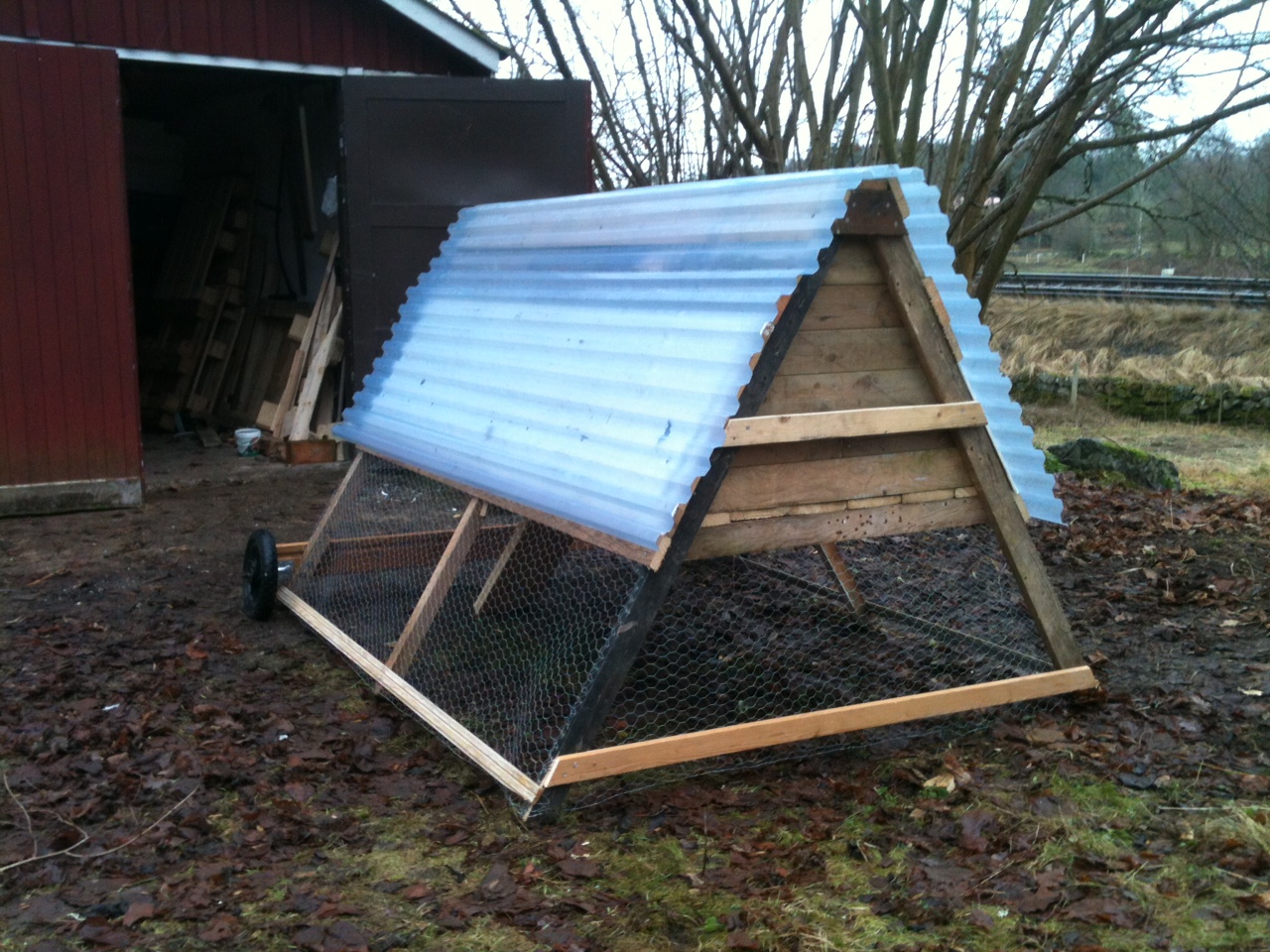
Chicken Tractor is Finally Finished

Yes, the chicken tractor is finally completed :) I am realy happy with it!
 to the right are two nests (35x35cm), at the back is the DIY feeder, the little bucket to the left is for crushed snail shells and coal dust (good for digestion and egg shell production) and the bigger bucket to the right is for water. The nest will be filled with hay and dry fern leaves (against pest)
I have made this feeder from 3 different buckets. The red lid is from a big bucket, medium bucket body and another lid from a small container which will close the hole on the feeder after filling it up with chicken food. The whole structure is fixed with wire and a screw.
 the chicken wire was stapled to the timber
 finished chicken tractor :)
Im still to paint the inside with chalk which is to prevent pests laying eggs in the walls. Im also to paint the outside, especially the legs which will be exposed to rain and snow.
I will buy 3 hens as soon as the weather gets warmer.